
Most church leaders didn't go into ministry to manage spreadsheets. But at a certain size, the spreadsheets show up anyway, and they don't care about your calling.
Churches with 1,000 or more members often run operations that rival a mid-size nonprofit: paid staff of 15 to 40, annual budgets in the millions, multiple facilities, dozens of programs, and hundreds of volunteers to coordinate. The administrative demands are real. When the systems to handle them aren't in place, things break down in ways that are embarrassing at best and damaging at worst.
What large churches actually manage
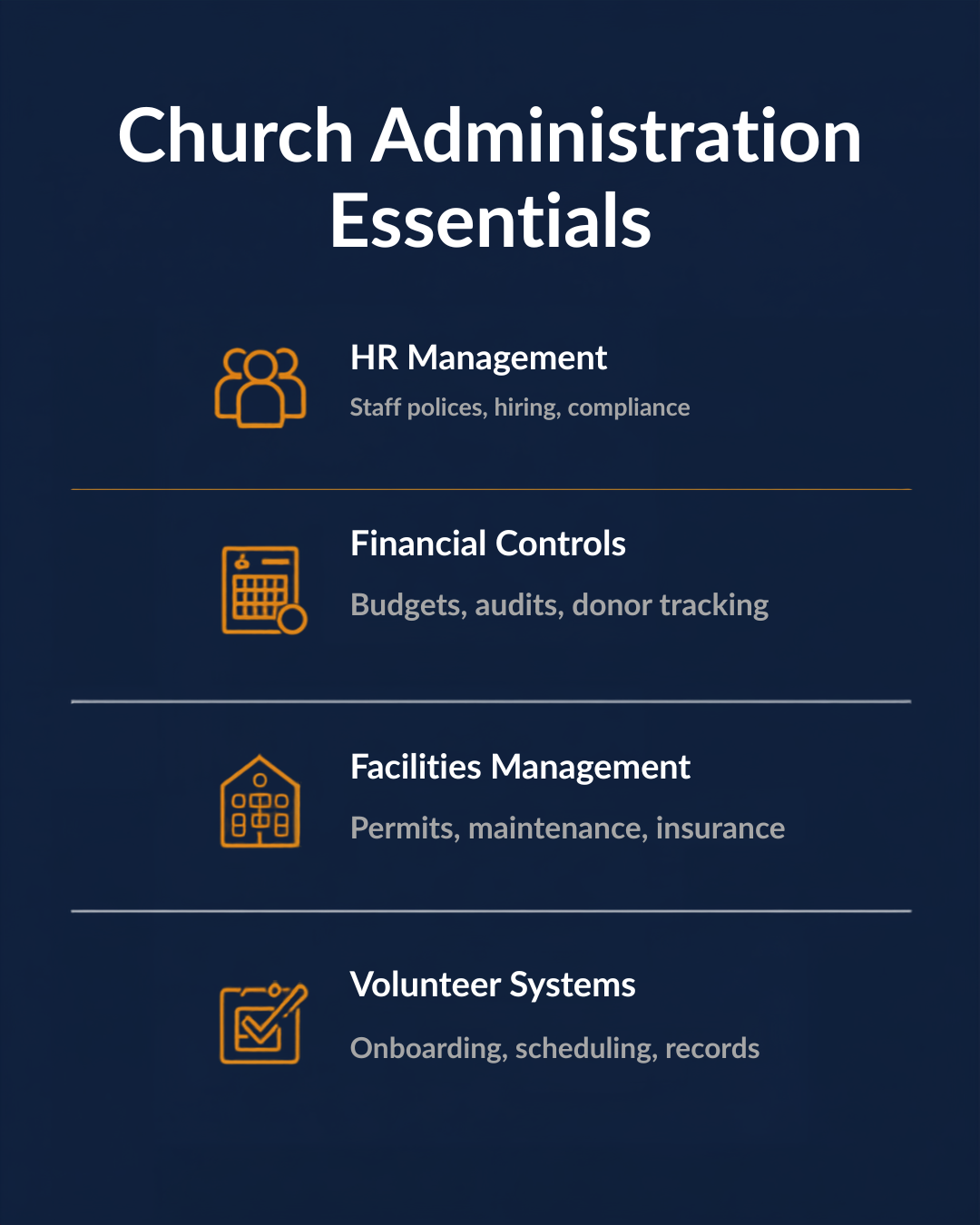
The scope catches many churches off guard. On the HR side: background check procedures for staff and volunteers, employee handbooks with actual legal standing, consistent onboarding for new hires, and clear processes for addressing performance issues. On the financial side: donor database management, restricted fund accounting, expense approvals, payroll compliance, and annual audits. Then there are facilities: lease agreements, permits, maintenance schedules, and insurance requirements. Add vendor contracts, copyright licensing for worship music, and the data privacy considerations that come with membership databases, and you have an organization that needs professional administrative capacity to function well.
None of this is secondary to the church's mission. Poorly handled HR creates staff turnover that disrupts ministry. Financial disorganization erodes donor trust. A facilities incident that falls through the cracks becomes a liability. The administration is the infrastructure the mission runs on.
Where churches tend to fall short
The most common gaps are predictable. Policies exist but haven't been updated since the church was a fraction of its current size. Staff get hired without formal job descriptions or onboarding plans. Financial controls rely on one or two people who have always handled things a certain way, with no documentation and no backup. Volunteer management runs on institutional memory rather than actual systems.
There's also a tendency to treat professional HR practices as something corporate organizations need but churches don't. That assumption creates risk. A church with 30 employees operates under the same labor laws as any other employer. FMLA, ADA accommodations, workers' compensation, and wage-and-hour requirements apply regardless of tax-exempt status.
What professional training changes
The difference usually isn't about buying better software. It's about church office staff understanding why certain systems matter and how to implement them consistently. A business administrator who has been trained in HR compliance handles a performance conversation differently than one who is winging it. An executive pastor who understands nonprofit financial controls asks different questions of the treasurer.
Training programs designed specifically for church operations address the intersection of legal requirements and ministry culture. That context matters. A church HR policy needs to comply with employment law while also reflecting the organization's values and pastoral approach. A financial reporting system needs to satisfy auditors while also being readable to a board of elders who are not CPAs.
LearTree Training offers workshops for church administrative staff covering HR fundamentals, financial accountability, and operational systems, designed for the realities of large-church management. Programs can be delivered on-site for staff teams or adapted for leadership groups. See available church administration training programs for details.
Getting the infrastructure right
A well-run church at scale doesn't happen by accident. The ministry side gets enormous attention: preaching, worship, pastoral care, outreach. The administrative side often doesn't get the same investment until something goes wrong.
The churches that handle growth well are usually the ones that treat administration as a professional function, staff it accordingly, and train the people in those roles to do the job at a high standard. The mission matters too much to let the infrastructure around it run on good intentions alone.